“The archive conceals, distorts and silences as much as it reveals…”
This week I learned to apply exploratory data analysis in my understanding of the course material. More specifically, I learned to manipulate data frames and 2D data structures and to subset data frames. We also learned about how to produce and read scatterplots to investigate possible correlations between the elements in our observations. These are very helpful tools when we want to get a sense of the trends happening with the data we are working with. To be able to represent data through visualizations lets us save time.
I always knew that there is a certain amount of caution that should come with reading historical facts and analyzes, but I never understood the underlying reasons why. This week, I understood that since data is not neutral and naturally occurring, it cannot be objective. In fact, we learned that it is very subjective, especially since it is subjected to many human biases. We pondered about this occurrence only to realize that, oftentimes, quantitative data has been manipulated to erase history or to paint a picture that is not the most accurate about the situation it aims at describing – to paint a story which aligns more with the narrative we want to show to the world. This is where the need for reparation comes in. I realized this when reading the article ‘Cotton Comes to Harvard” by Wilder about Harvard’s perverse relationship with the money it received . The following question arises: how do we ensure that quantitative data does not become a flawed representation of the past? The ugly truth is that a number of universities in the US benefited from donations from rich white men who earned money on the back of the people they enslaved. The fact that these schools choose how to tell the story of their past is utterly abject and untruthful – the past cannot be narrated with half-truths and disguised lies. When we come to think of it, Bates is not that different from Harvard. For Bates and Harvard to call themselves ‘abolitionists’ and to extrapolate this part of their story when, in reality, they have condoned the acts of enslavers is an act of deception. Hence, data analysis should be a tool to help dismantle the lies, not to uphold them. It becomes clear that there is much work to be done in terms of authentification of already existing records not only to investigate their degree of veracity, but to account for what they do not tell as well.
This week, we learned a great deal about Bates’ past. More specifically, we analyzed data from donations made to the college during the late 1850s. The data we analyzed is from the Maine State Seminary and displays a record of donors. Other pieces of information we are given are the date of the transaction and the amount. In most cases, donors are identified by their first and last names.
plot(data$Day, data$Amount)
#This will plot the amount in dollars on y-axis
#and day of the month on x-axis
Consider the following scatter plot which has been produced using the code above. When using scatter plots, we aim at finding if there is a pattern in the data we are analyzing. Here, we have a display of the amount of the donations and the day of the month on which they occurred.
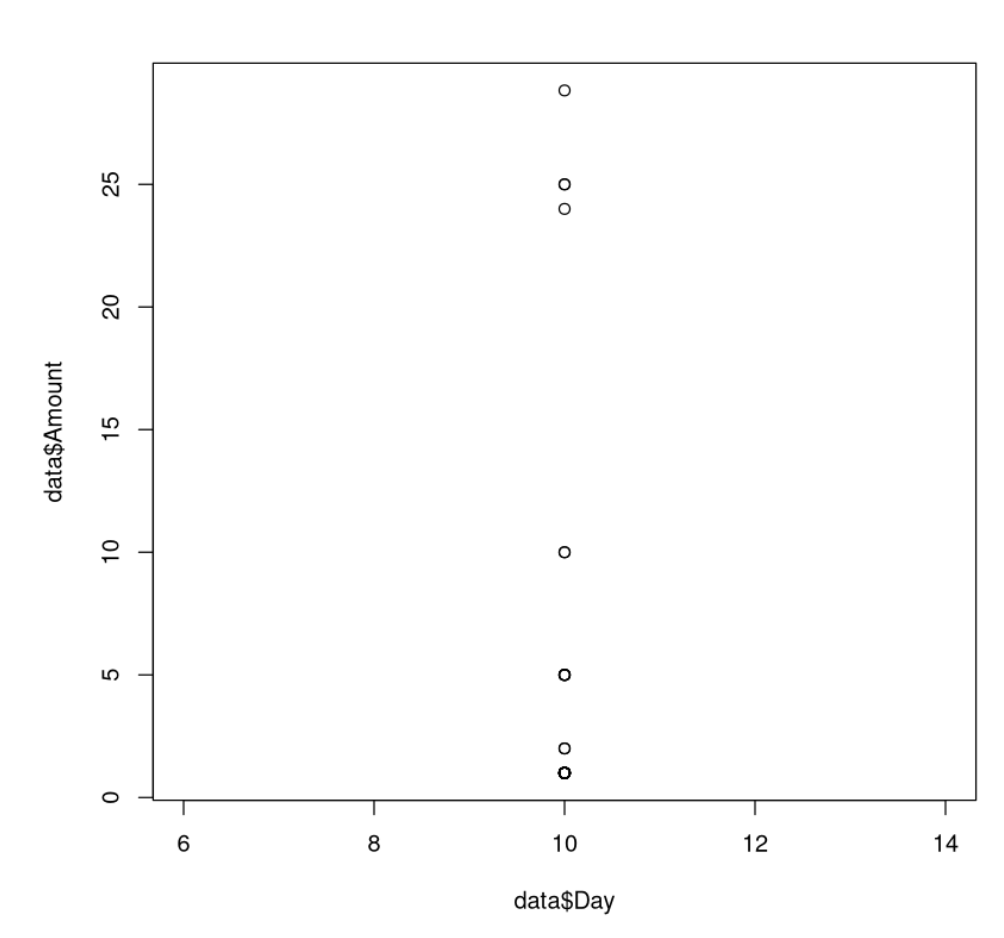
We see that all of the donations took place on the 10th of that month, which turns out to be August. Normally, we would use the code below to investigate a correlation between the two parameters.
cor(data$Day, data$Amount) However, since all the transactions happened on the same day, such a calculation is vain, as shown below.
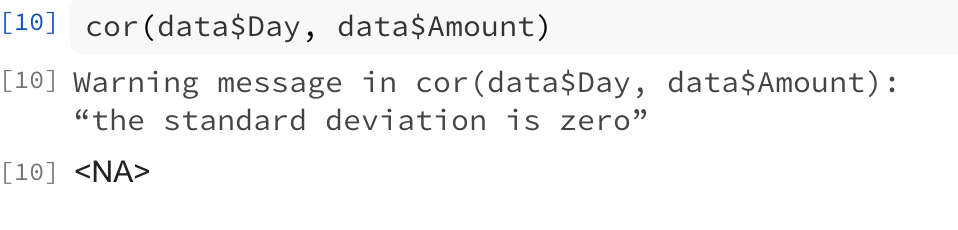
We might want to investigate what happened on that 10th of August 1857 to explain why all of these transaction happened on that very day. In this particular case, we cannot deduce a substantial correlation besides the one we just noticed. To quote Marisa Fuentes, “the archive conceals, distorts and silences as much as it reveals.” This is a clear example of this. Although we have records of names and donations, they do not explicit tell us where the money they contributed comes from. This is an information we would greatly benefit from especially in the discourse about Bates’ financial past.
